Looking at a lawn doesn’t provide much diagnostic information, for a lot of reasons. Different types of grass have different water needs. So do trees and shrubs. Areas that get more sun need more water than shaded spots. Soil conditions vary widely, as do microclimates.
Maybe the biggest reason looking at the grass doesn’t work is that it never tells you what the other side of the rooting zone is doing. Water too much in most of the country, and it drains down to the water table, which is a waste. Water too little, and it doesn’t immediately show, but a few weeks later, things start dying.
That’s the motivation behind “smart” irrigation systems that use sensors to directly measure soil moisture, the most important variable in how much water to deliver. Other components of these systems calculate weather conditions, evaluate slope and runoff issues in each part of the yard, and adjust irrigation timing and volume accordingly. Small wonder they can reduce waste by 30-50%.
Visible waste versus invisible waste
Most advice on water conservation suggests simple actions. Fix the broken sprinkler head. Turn the timer off when it rains. Replace the old, inefficient nozzle. These are easy solutions to the waste you can see because you can see it.
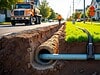
Fixing underground leaks doesn’t play by those rules. When you develop a leak at a supply line fitting or a joint, it might flow for months on end without ever reaching the surface or causing a single observable sign. Soil is good at wicking and spreading water. Sometimes that leak’s only warning comes in the form of an area of grass that’s just a little greener than the rest, or grass that’s taller and thicker in one isolated spot – and people generally assume those are good things, not hidden leaks.
According to the EPA’s WaterSense program, up to 50% of the water we use outdoors is lost to wind, evaporation, and runoff due to overwatering and inefficient irrigation. Undetected leaks eat into that figure in an unknown but significant way. Leaks probably account for a few percentage points of the total water we use outside, which adds up to a lot of drinking water disappearing into the ground for no good reason – not in the service of a healthy lawn or a good property owner.
The environmental cost nobody talks about
It’s easy to think of a leaking pipe as a money problem. Higher water bill, maybe some soil erosion, an inconvenience. But the environmental math runs deeper than the water itself.
Every gallon that leaves a treatment plant has already consumed energy. It’s been pumped, filtered, and often chemically treated before it ever reaches a property line. When that water seeps out of a broken irrigation pipe and into the soil, all of that energy and treatment investment is wasted along with the water. This is sometimes called the water-energy nexus – the idea that water and energy use are tightly linked, so wasting one means wasting the other. A leaking irrigation pipe isn’t just dripping water into the ground. It’s quietly generating carbon emissions for zero return.
Scale that up. Municipal water systems already lose a substantial percentage of treated water before it even reaches customers – what utilities call non-revenue water, lost to leaks, theft, and metering errors in the distribution network itself. Add millions of residential and commercial irrigation systems leaking on the customer side of the meter, and the aggregate pressure on reservoirs, aquifers, and the energy grid becomes real. One leaking pipe on one property looks trivial. Multiply it across a neighborhood, a city, a region under drought stress, and it stops looking trivial at all.
Why smart controllers can’t fix a broken pipe
Advanced irrigation systems are becoming more and more efficient. For instance, weather-based controllers receive local weather data and adjust the irrigation schedule according to the rain or low evapotranspiration rates. Likewise, soil moisture sensors can accurately determine when water needs to be applied and in which amount, as they measure the soil moisture directly at the root zone. These advancements have truly been a solution to a problem we had: the overwatering due to a pre-fixed schedule that doesn’t take into account the actual conditions.
However, here’s something we are ignoring. All of these improvements optimize the demand side of irrigation: how much and when to apply water. But what happens between the water supply and the irrigation system? If a pipe is leaking, the water will be lost underground well before it gets the chance to hydrate your garden, your lawn, or your golf course. And so, the smartest irrigation system will keep delivering water to a system that’s constantly losing water that will never reach its destination – the plants.
Finding what you can’t see
Visual inspection can only go so far once a pipeline is put in the ground. You might do a complete walk of the property, eyeball every sprinkler head and check for the presence of wet soil, only to come up empty-handed on where a leak exists several feet underground and is slowly seeping away undetected. This is the part where the methods the professionals bring to their work prove to be worth every cent.
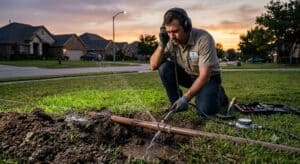
The most common approach to locating a leak in an underground pipeline is acoustic leak detection. Water forced under pressure through either a crack or a failed joint in the line generates a unique sound signature that a technician armed with the right listening hardware can identify with far greater precision than any human eye squinting over the ground can. Flow monitoring is another piece of the puzzle – when estimated flow rates to a location are compared against actual usage, it can sometimes raise a red flag before anyone spots a damp spot in the grass. Some systems combine flow monitoring with automatic shutoff and halt delivery of water instantly when flow usage seems off.
When your water bill ticks up sharply and there’s no easy explanation right at the surface, well, an educated guess is still a guess. But it is the hint that it is time to bring in a leak detection service for irrigation lines if you really want to find the source. Techs will isolate zones, pressure test the line, and use their listening gear to track the sound of water escaping from the line directly to the point of failure without you ever having to dig up the entire yard on a hunch. It matters. Both in terms of how big the final repair bill is and how much water is wasted in the meantime.
Why these leaks go undetected for so long
Identifying underground irrigation leaks is a challenge. They do not cause the same type of immediate obvious damage that a broken pipe in the house would. There is no flooding, no spray, and often no change in water pressure that would be detectable through normal use. The water simply trickles away unnoticed, day after day, week after week.
A pinhole leak in a supply line can lose thousands of gallons in a month. Before long, that makes a significant amount of treated water wasted, and it’s water you’re paying for but not using. Yet because the leak is underground, many property owners are likely to assume that their water bill has crept up because they’re watering more often in the heat, or for longer to establish new grass or plants. The truth is that hole in the ground a few inches from the sprinkler head.
Invisible damage is being done as well. Soil is constantly moist and this can erode it. Water washes out from under sidewalks and patios, causing them to sink and become uneven. Uneven settling contributes to the deterioration of pumps and motors while the constant damp will attract pests. Given enough time, the cost of repair and replacement will only grow while you pay an ever-increasing bill – all because of a small hidden leak.
Pressure: the quiet cause behind most failures
Many irrigation pipe failures can be traced back to a single culprit: pressure. Pipes, fittings, and joints are all created to operate within a specific pressure range, and when municipal supply exceeds that range (or when pressure spikes occur because of valve operation or weather), the weakest points of the system will begin to fail. A joint that was perfectly fine for years can break the moment it encounters the pressure spike it can’t handle.
Pressure-reducing valves help control this by maintaining a safe supply pressure for the irrigation network. Pressure testing regularly, ideally during seasonal maintenance, will catch those early pressure stress warning signs before they become complete failures. It’s a cheap insurance policy against a problem that becomes expensive very quickly as soon as a pipe goes underground.
The case for a seasonal audit
At the start of the watering season, an irrigation system audit is one of the more underused tools available to property owners. A proper audit checks sprinkler heads for wear, tests valves for proper operation, verifies pressure across zones, and inspects accessible piping for early signs of trouble – all before the system runs at full capacity for months on end.
Catching a failing seal or a cracked fitting during an audit is a lot cheaper than discovering it three months later through a water bill that’s doubled. It’s also a natural point to evaluate whether a property would benefit from converting high-water-use zones – turf grass areas remain the single largest end use of residential outdoor water – to more efficient delivery methods such as drip irrigation, which loses far less water to evaporation and overspray than conventional spray heads.
Regulation is catching up to the waste
Drought and watering restrictions are becoming more stringent in many places. Some municipalities with water-stressed populations are limiting days of outdoor watering, the number of hours watering can take place, and the volume of water that can be used for irrigation. In extreme cases, enforcement could be based on smart meter data that indicates water use over time, and automatically flags usage often associated with leaks.
An undetected leak means that water costs are passing the property owner by, but it also could push property usage over the fines-and-fees threshold or become a rare or abnormal use of water that triggers investigation even in areas where local governments are restricting usage without promoting waste awareness. As irrigation systems become more difficult or expensive to operate under such restrictions, this is likely to push physical compliance as a consideration for more property owners than would otherwise be the case.
Fixing the leak is the actual sustainability move
When we talk about sustainability and irrigation, we usually highlight what is most visible or palatable – drip lines, native plants, smart controllers, etc. All good things, nothing wrong there. However, the single highest-leverage action we can all take as stewards of our little piece of Earth is to find and fix those leaks we can’t see. A gallon saved from a repaired pipe is a gallon you didn’t need to pump, or treat, or draw from an already stressed aquifer in the first place.
Your lush green grass doesn’t mean you have a healthy system; it just means the leak hasn’t caught up with the visible symptoms yet.