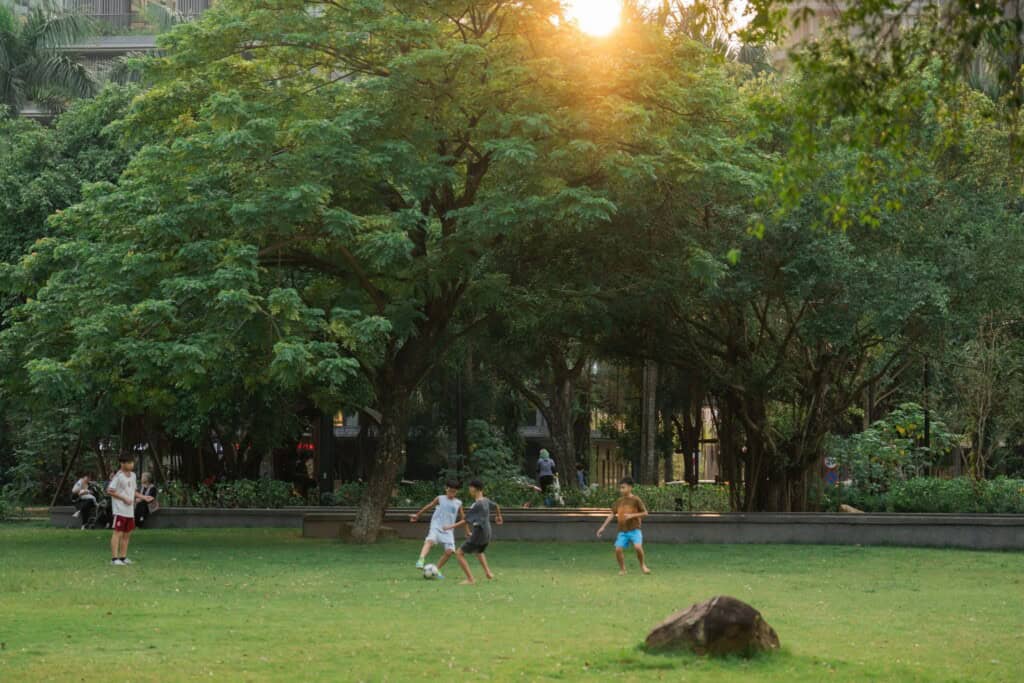
For a long time, calling a property in Thailand a wellness property was mostly a marketing exercise. A spa on the ground floor, a yoga deck, some greenery in the brochure renders, and the label stuck. That bar has moved. Industry research now frames wellness residences around measurable performance rather than atmosphere, naming air quality, water quality, light, acoustics, walkability and social connection as the core design factors that separate a genuine wellness property from one that simply borrows the word.
Nowhere is that shift more relevant than around Bangkok, where the air itself has become the thing serious buyers are quietly researching before they research anything else. Global wellness real estate is now valued in the hundreds of billions of dollars, and the sector’s own trend reporting points to the same conclusion from a different direction, that healthy building design is shifting from a luxury add-on toward a basic market expectation. For a wellness property specifically marketed on that promise, the standard it has to meet keeps rising every year.
When the Dry Season Arrives, So Does the Real Test
Bangkok’s PM2.5 problem is seasonal, predictable, and well documented at this point. Each year between roughly November and March, vehicle exhaust, construction dust, industrial emissions and cross-border agricultural burning combine with calm winds and temperature inversions to trap fine particulate matter close to the ground. In January 2026, citywide averages in some central districts reached as high as 58 micrograms per cubic metre, well above Thailand’s 24-hour standard of 37.5 micrograms per cubic metre, with several neighbourhoods briefly touching hazardous levels. The severity of the pattern led Thailand’s National Environment Board to formally designate Bangkok a pollution control zone in late 2025, triggering a set of stricter citywide measures, including a low emission zone, for 2026.
None of this is abstract for a family evaluating where to live long term. A home that looks identical to a competitor on a floor plan can sit in a very different air quality reality depending on its distance from arterial roads, industrial clusters and construction activity, and depending on how much genuine green buffer actually surrounds it.
By March 2026, Thailand’s Pollution Control Department reported that the worst of the season’s crisis had passed, with average readings across Bangkok and its surrounding provinces easing compared with the year before. That is a genuine improvement, and it is also a reminder of how narrow the margin still is. Even in an improved year, the number of days that exceeded the national safety standard actually rose slightly, and officials were candid that occasional spikes remain likely through the seasonal transition. A wellness property that only looks good on its best days is not the same as one built to perform on its worst.
Spa Amenities Were Never the Real Definition of Wellness
Across the industry, the definition of a wellness property has been rewritten around infrastructure rather than imagery. Wellness real estate research now describes wellness residences as developments that optimise the built environment for long-term health, citing air quality, water quality, light, acoustics, walkability and social connection as the defining criteria, with longevity-focused developments layering preventative health services on top. Separately, luxury market outlook research frames wellness as having moved from a premium add-on to a baseline expectation, with buyers now assuming advanced air and water filtration, biophilic design and natural lighting systems as standard rather than upgrades.
In other words, the question a serious buyer is increasingly asking is not whether a development has a spa, but whether the air inside and immediately around their home meets a standard they can actually verify.
Filtration Alone Cannot Solve an Outdoor Problem
This is where many wellness-branded developments fall short. Indoor air filtration systems, however advanced, only manage the air inside four walls. A genuine wellness property is meant to support a life lived outdoors as much as indoors: morning walks, children playing, golf, cycling, evenings on a terrace, and none of that is protected by a filter in the living room.
What actually protects that outdoor life is structural rather than mechanical: distance from congested traffic corridors, the ratio of green space to built space, and overall population density. A development built on a small, tightly packed plot in the middle of a dense city is working against itself no matter how good its indoor systems are. A development built at genuine scale, with wide green buffers and low density by design, has a structural advantage that no filtration system can replicate.
A Different Model Is Emerging North of the City
Several newer communities positioned around Bangkok are being planned explicitly with this structural advantage in mind, built on large landholdings with extensive tree cover, wide setbacks from major roads, and a resident density kept deliberately low compared with the inner city.
When investigating a wellness property bangkok investors can rely upon for long-term health. Reignwood Park serves as a notable example of infrastructure-led environmental design. Spanning 2,000-rai (~800 acres) north of the capital, the development prioritizes wide setbacks and natural buffers over high-density urban planning. By integrating a championship golf course and extensive parkland with low-rise residential units, the township creates a structural shield against pollution, facilitating a lifestyle where movement occurs along dedicated green corridors rather than congested transit routes.
For a buyer weighing a wellness retreat experience against a genuine long-term home, this kind of township model comes closer to combining the two. Recovery-oriented infrastructure, a golf course, sports facilities, and open parkland become part of everyday life rather than something visited occasionally on holiday.
What to Actually Check Before Believing the Word Wellness
Before accepting a wellness property claim at face value, it is worth asking a developer for specifics rather than adjectives:
- Published air quality monitoring data for the site itself, not just citywide averages, since a single central reading can hide significant differences between neighbourhoods
- The actual green space to built space ratio, not just a count of trees in a rendering, since density is what determines how much a green buffer can genuinely do
- Distance from major arterial roads, industrial estates and active construction zones, since these remain the dominant local sources of fine particulate pollution
- The building’s air filtration and air exchange standard, not just a general claim that air purification is available, since specifications vary widely between developments
- Genuine outdoor recovery infrastructure, walking tracks, sports facilities and parkland, rather than a single indoor gym, since a wellness lifestyle that only exists indoors defeats its own purpose
Air Quality Is the New Baseline, Not the Bonus
Thailand’s air quality challenge is not going away quickly. Officials have acknowledged that Bangkok is easing from its worst pollution peaks, but they have also been candid that spikes will keep recurring each dry season, and the city’s own ten-point plan for 2026 is designed to manage the problem rather than eliminate it overnight. For a buyer evaluating a wellness property near Bangkok, that reality changes what due diligence actually looks like. Air quality is no longer a footnote in a wellness brochure. It has become the test the rest of the claim has to pass.